Getting started Asset allocation and diversification

Typically, a mix is better than a single investment

Asset allocation and diversification can help you strike the right balance between risk and return in your portfolio. Holding a broad range of investments can help lessen the impact that any one economic or market event has on your portfolio. That’s because different investments tend to gain or lose value at different rates and at different times.

A healthy mix

Asset allocation refers to the different weightings of stocks, bonds and cash in your portfolio. Because these three asset classes have tended to deliver varying risk profiles and rates of return, asset allocation plays a role in helping you achieve your investment goal.


Diversification takes this process one step further by spreading your money across different investments within the same asset class. Rather than trying to figure out which type of stock or bond will perform best, you would invest in multiple types. Over time, the ups of one investment have the potential to balance out the downs of another, with the goal of reducing the risk level in your portfolio.

Here’s how asset allocation and diversification shape a portfolio.

Here’s how asset allocation and diversification can shape a portfolio

The pie charts depict two portfolio asset allocation strategies. The chart to the left displays a portfolio allocated across three main asset classes: stocks, bonds and cash. The chart to the left displays more than half of the portfolio allocated to stocks, the second highest allocation to bonds and the least allocation to cash.

Across asset classes

This portfolio is allocated across the three main asset classes. Your asset allocation will depend on your investment goal, time horizon and risk tolerance.
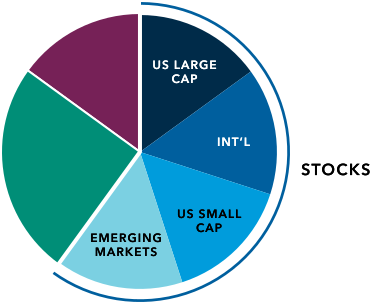
The chart to the right displays the same portfolio allocated across the same three main asset classes and equally breaks down the stocks asset class allocation into four categories: U.S. large cap, international, U.S. small cap and emerging markets.

Within an asset class

While stocks retain the same percentage allocation, this portfolio shows how stocks are now diversified across investments that vary by size and geography.


Allocations shown for hypothetical purposes only. Financial professionals should tailor portfolios according to the needs of investors.


Spread out your money

Asset allocation can have a big impact on your portfolio’s rate of return. In general, stocks are riskier than bonds, though investors may need both. Your investment goal, risk tolerance and time horizon help determine the best asset class mix for you.


Because asset classes typically don’t rise and fall at the same rate, you’ll probably need to rebalance your portfolio periodically. Rebalancing helps maintain your intended asset allocation. Many investment firms offer the option to sign up for automatic rebalancing.

Fine-tune your portfolio

Using individual investments to diversify by geography, size and industry can be a challenge. That’s why many investors rely on mutual funds. Building a portfolio comparable to a mutual fund’s would require significant time and resources. A typical stock fund can hold 75 to more than 100 different investments. Further, it can cost more to buy a single bond than to meet the minimum investment of a bond mutual fund.

Learn more about investing

Now that you understand asset allocation and diversification, explore other important investment concepts.

Investments are not FDIC-insured, nor are they deposits of or guaranteed by a bank or any other entity, so they may lose value.
Investors should carefully consider investment objectives, risks, charges and expenses. This and other important information is contained in the prospectuses and summary prospectuses, which can be obtained from a financial professional and should be read carefully before investing.
All Capital Group trademarks mentioned are owned by The Capital Group Companies, Inc., an affiliated company or fund. All other company and product names mentioned are the property of their respective companies.
Use of this website is intended for U.S. residents only.
Capital Client Group, Inc.
This content, developed by Capital Group, home of American Funds, should not be used as a primary basis for investment decisions and is not intended to serve as impartial investment or fiduciary advice.