Client Conversations
 Max McQuiston
Periods of market volatility can shine a spotlight on the critical role you play in helping clients stay the course in turbulent times. Your guidance could transform challenges into opportunities, demonstrate your value and help clients make smarter financial decisions.
“One of the most valuable aspects an advisor brings to a client relationship is helping to manage emotions during periods of market volatility,” says Max McQuiston, advisor practice management consultant at Capital Group. “In fact, volatile markets provide a great opportunity for advisors to be proactive — to reach out to your most valuable clients and prospects and offer reassurance about the plan you have in place for them.”
To help manage these conversations in a productive way, we have developed a four-step framework for client conversations. It provides you with a repeatable way to take these opportunities to strengthen relationships with clients and help keep them focused on their long-term goals.
Here's how to apply these four steps to your proactive conversations with clients about recent market volatility and what it could mean for them.
1. Acknowledge concerns with empathy
The first and perhaps often overlooked step when addressing client concerns is taking in those concerns in an active way. “I go back to habit five from Stephen Covey’s book, The 7 Habits of Highly Effective People: Seek first to understand and then to be understood,” McQuiston says. “It’s easy to start talking too soon without first making sure clients feel heard and understood.”
Clients may just be looking for a sounding board or for reassurance. The more you can really listen and empathize with what they are saying, the better you’ll be able to identify what they need from you. Additionally, at a time when many advisors are trying to figure out ways to differentiate, empathy can add a lot of value. “This is an example of what AI does not do well,” McQuiston adds. Reach out to ask, ‘Hey I know there’s a lot going on, how are you feeling?’
2. Provide broader perspective
Putting today’s concerns into a larger context may help provide something else to focus on. As unprecedented as the headlines seem, historical data can help put current events into perspective. “While history doesn’t exactly repeat itself, it often rhymes,” McQuiston says.
Even recent history can serve as an example. Of late, a pandemic, wars, inflation and high tariffs have sent shock waves through the global economy. For many investors, sitting on the sidelines as these events unfolded may have seemed the most sensible response. Yet, time after time, financial markets pushed through turbulence to reach new highs.
The stock market has climbed past several crises
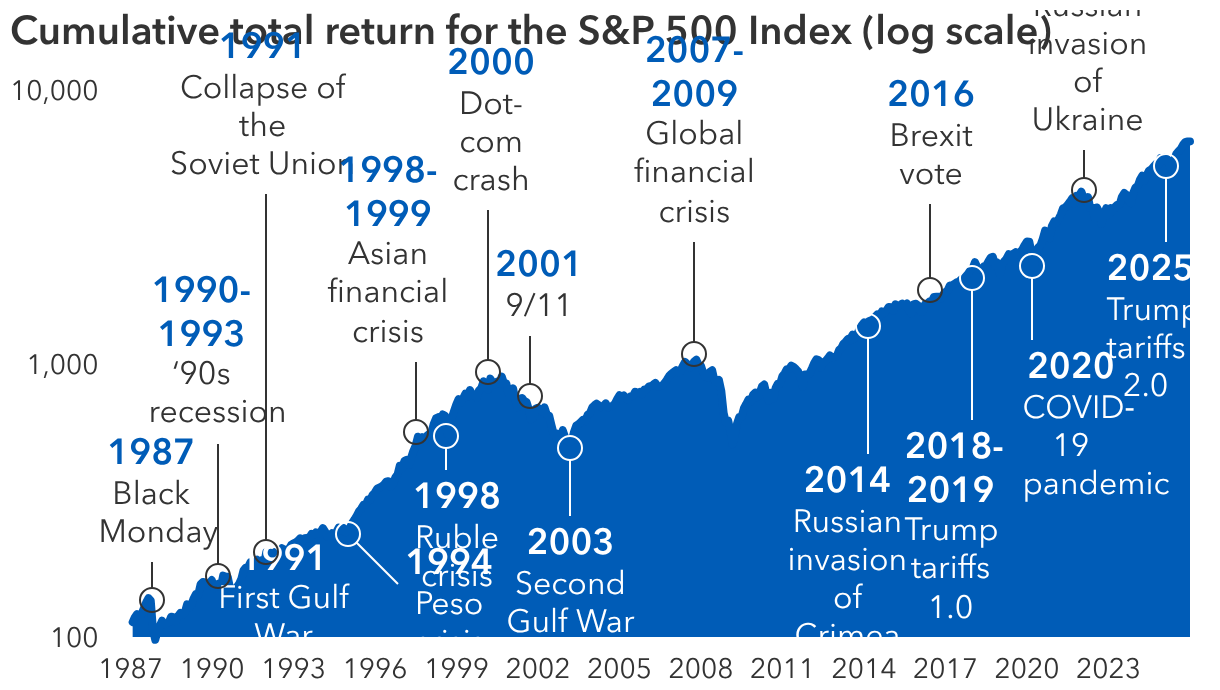
Sources: Capital Group, Standard & Poor's. As of December 31, 2025. Data is indexed to 100 as of January 1, 1987, based on cumulative total returns for the S&P 500 Index.
For clients concerned about events in the Middle East or Venezuela, it may be helpful to point out that at least over the past few decades, geopolitical events don’t tend to have a lasting impact on markets. Even energy markets have generally bounced back quickly from geopolitical shocks.
If political uncertainty is a concern with midterm elections on the horizon, remind clients that midterm years have generally been positive for the market. From 1950 to 2023, the average one-year return after a midterm election year was 15.4%.
Markets have rebounded sharply after midterm elections
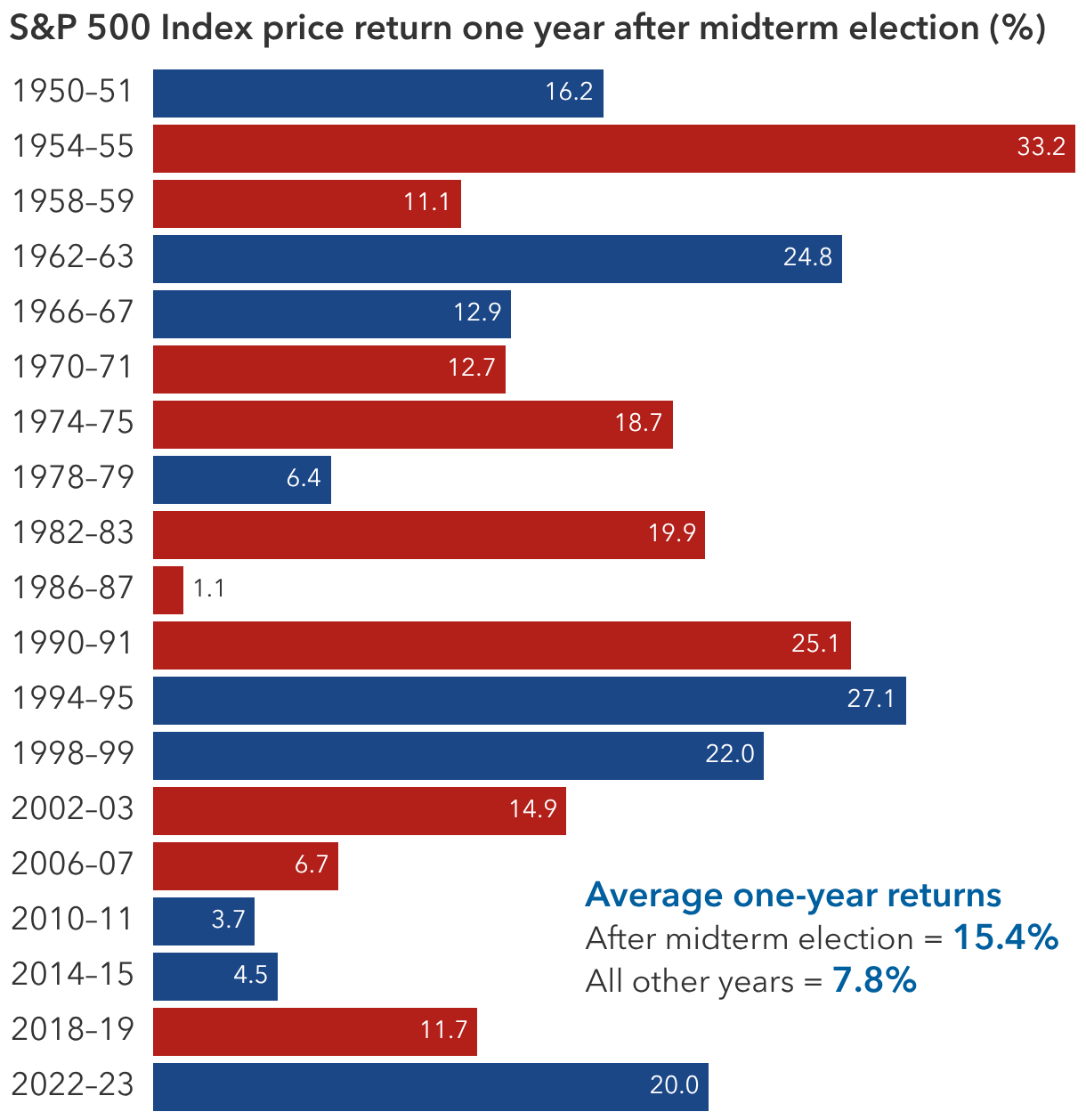
Sources: Capital Group, RIMES, Standard & Poor's. Calculations use Election Day as the starting date in all election years, and November 5th as a proxy for the starting date in other years. Only midterm election years are shown in the chart. As of December 31, 2025.
Charts are great reminders that there have always been reasons not to invest, yet over time the markets have proved resilient. Declines can happen, and what has happened in the past is not predictive of what will happen in the future, but history shows that investors who look beyond short-term uncertainty and remain committed to their long-term goals have often been rewarded.

NEW service! Chart Stories
A library of client-ready charts at your fingertips
3. Focus on areas of confidence
“While geopolitical events can change sentiment fast, fundamentals change at a much slower pace,” McQuiston explains. Take the time to remind your clients of areas of economic confidence that remain, like the examples in 5 keys to investing in 2026:
- Bold stimulus around the globe. The economic landscape is expected to improve in 2026, as governments worldwide roll out bold stimulus in response to slowing growth and trade barriers.
- Lower interest rates. The U.S. federal funds rate is expected to end 2026 near 3%. The rate influences borrowing costs worldwide, and lower rates could support business and consumer spending. Historically, Fed easing cycles that occurred outside a recession have lifted stock and bond markets, while cash lagged.
- Rising company profits. Consensus earnings estimates are looking brighter, largely due to declining interest rates, government stimulus and a string of trade deals that have reduced policy uncertainty.
Timing the market can be costly
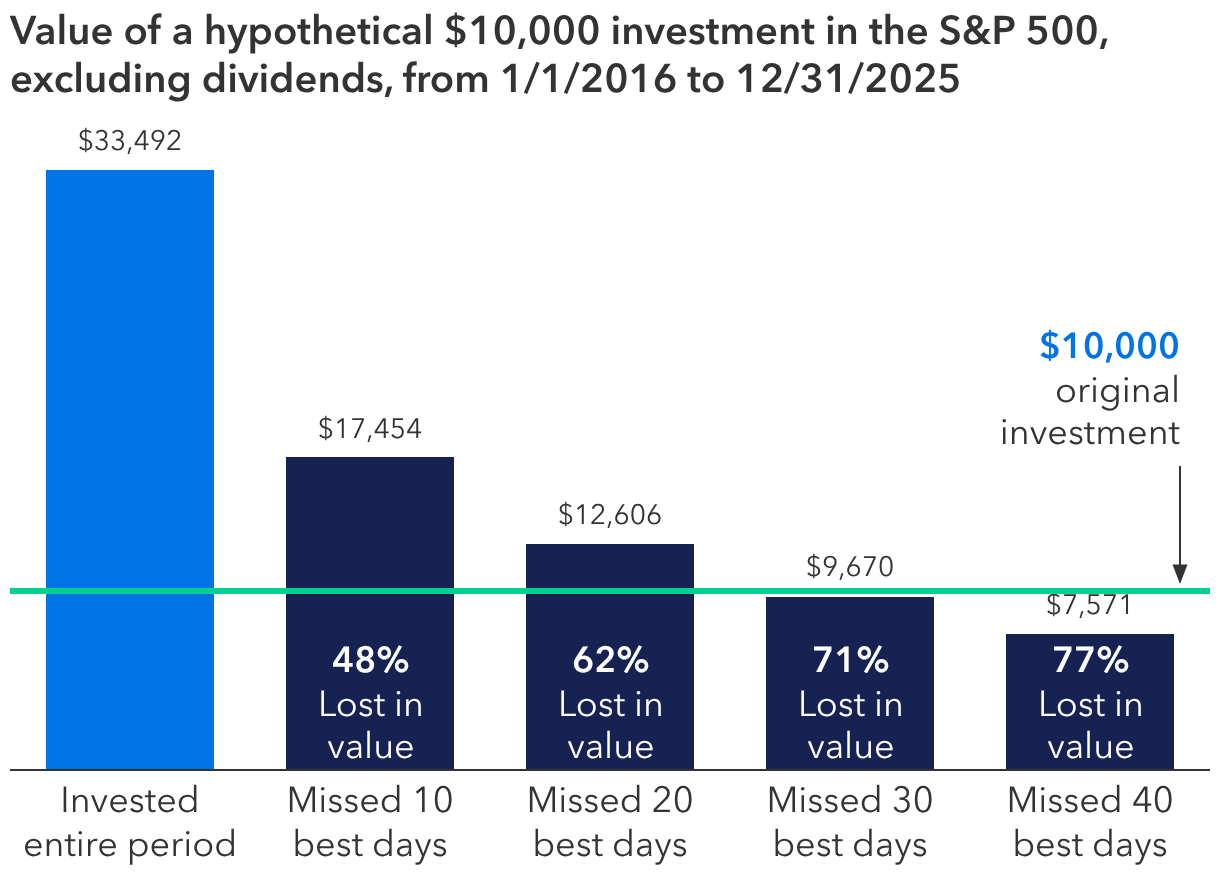
Sources: Capital Group, RIMES, Standard & Poor's. As of December 31, 2025.
Most importantly, express confidence in the plan you have created for your client. “Remind clients that we’re not trying to predict what's going to happen. We have a process and have a plan that’s designed to be durable.
“We don't need to be perfect but we do need to be consistent,” McQuiston adds. That’s because timing the market can be costly. History shows that a decade’s worth of returns can hinge on just a handful of strong trading days. Miss the 10 best days and a $10,000 stake would have ended up nearly 48% smaller than if you had simply stayed invested. Miss the 20 best days and the gap would have widened to 62.4%.
4. Find new opportunities
Once you have addressed your client’s specific concerns, you have an opportunity to zoom out and revisit their overall goals. “It’s a great time to be an advisor when markets are challenging because people are listening more. When everything's going up, they may not even call you back. When markets are going down, that's when you can advance the relationship,” McQuiston says.
Remind your clients of the opportunities that inevitable market downturns may create. For example, sometimes opportunity shows up as portfolio rebalancing rather than a swift decision to sell. Check in with the client on planning moves that could make sense. For example:
- Tax-loss harvesting. You might capture tax losses from positions that have declined for some investors, offsetting future capital gains.
- Roth conversions. Market declines may present an opportunity to convert traditional IRA assets to Roth accounts at lower prices, potentially reducing the tax impact.
- Dollar-cost averaging. For clients with cash on the sidelines, they might systematically invest during market declines to acquire more shares at lower prices without having to perfectly time the market.
- Trust strategies. Suggest clients consult with their legal professionals to assess whether they might benefit from grantor retained annuity trusts (GRATs), swapping provisions or other trust mechanisms to take advantage of current market conditions.
Sometimes the best opportunity is to do nothing, McQuiston concludes. “It’s not necessarily new or innovative, it’s just reminding people being patient is key.”

Regular investing does not ensure a profit or protect against loss. Investors should consider their willingness to keep investing when share prices are declining.
Past results are not predictive of results in future periods.
The market indexes are unmanaged and, therefore, have no expenses. Investors cannot invest directly in an index.
S&P 500 Index is a market capitalization-weighted index based on the results of approximately 500 widely held common stocks.
The S&P 500 Indexes are a product of S&P Dow Jones Indices LLC and/or its affiliates and have been licensed for use by Capital Group. Copyright © 2026 S&P Dow Jones Indices LLC, a division of S&P Global, and/or its affiliates. All rights reserved. Redistribution or reproduction in whole or in part is prohibited without written permission of S&P Dow Jones Indices LLC.