Chart Stories

Insights that go beyond the numbers. Use these charts to power your storytelling
and help clients make better investment decisions.

Market Volatility

Sharp declines in consumer sentiment often coincided with markets pricing in worst-case scenarios, creating attractive opportunities.

VIEW
Download

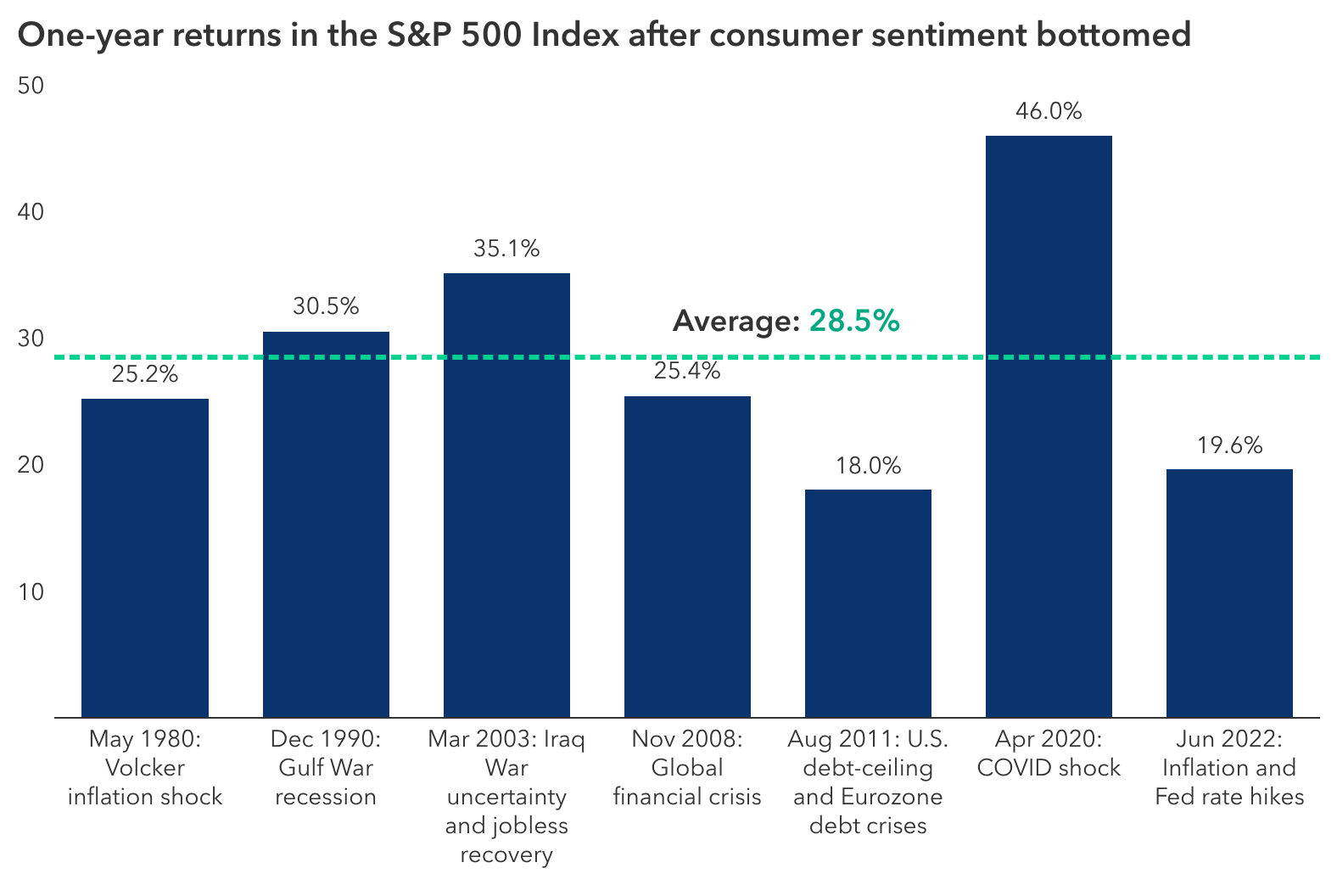
Extreme pessimism often preceded double-digit returns for equities

A series of vertical bars shows S&P 500 Index total returns one year after selected consumer sentiment cycle lows, including periods such as the 1980 inflation shock, the 2008 global financial crisis, and the 2020 COVID shock. Returns across the examples range from about 18 percent to 46 percent, with an average near 28.5 percent.

Sources: Capital Group, Bloomberg, S&P Global, University of Michigan. Consumer sentiment bottoms are reflected by cycle lows for the University of Michigan's Consumer Sentiment Index, which is a monthly survey-based index that measures U.S. consumers’ views on current economic conditions and expectations for the future. It is derived from household responses on personal finances, business conditions, and buying conditions, and is indexed to a base year of 1966 = 100. Returns reflect total returns, with start dates based on the end of each month listed for specific lows in sentiment. As of March 31, 2026.
 

Past results are not predictive of results in future periods.

VIEW
Download

Most popular charts

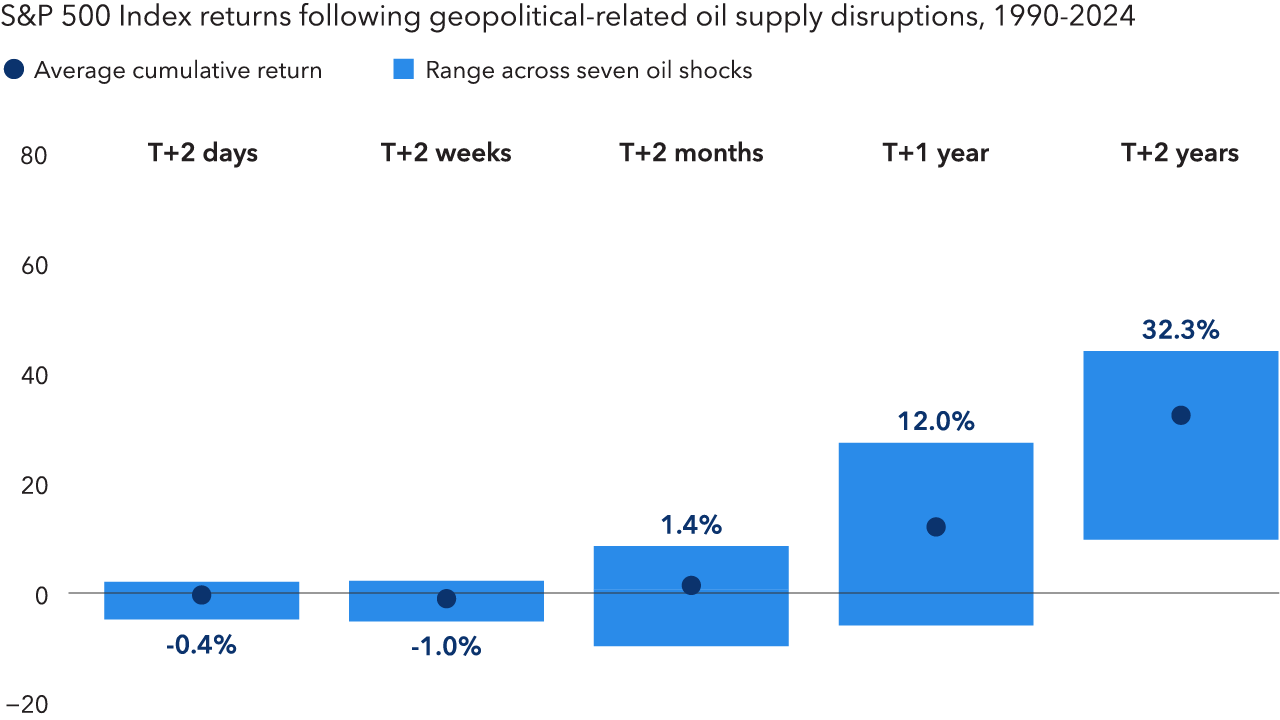
Selloffs tied to oil shocks have been short-lived

A dot and range chart shows S&P 500 Index returns following geopolitical‑related oil supply disruptions from 1990 to 2026 at multiple horizons. Average returns are slightly negative after two days and two weeks, turn modestly positive after two months, rise to about 12 percent after one year, and increase to roughly 32 percent after two years. Shaded ranges indicate wide variation across individual events, with dispersion narrowing and returns skewing negative at shorter horizons, while broadening with more positive skew at longer horizons.
VIEW
Download

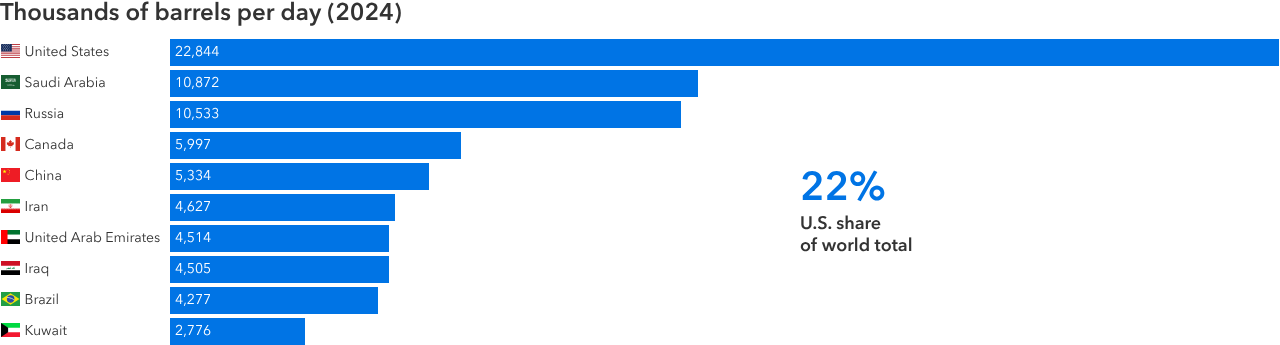
The U.S. is the world’s top oil and gas producer

A horizontal bar chart showing 2024 oil production rankings and global market share based on thousands of barrels produced per day, ordered from highest to lowest: United States 22,844, Saudi Arabia 10,872, Russia 10,533, Canada 5,997, China 5,334, Iran 4,627, United Arab Emirates 4,514, Iraq 4,505, Brazil 4,277, and Kuwait 2,776. U.S. share of world total is 22%.
VIEW
Download

Market surprises are a fact of life

Here is the alt text: Table summarizing S&P 500 declines from 1954 to 2025. Declines of 5% or more occur about twice per year and lasted an average of 46 days, most recently in October 2025. Declines of 10% or more occurred about every 18 months and lasted 133 days on average, last occurring in February 2025. Declines of 15% or more occurred about every three years and lasted 247 days on average, last occurring in February 2025. Declines of 20% or more occurred about every six years and last 402 days on average, last occurring in January 2022.
VIEW
Download

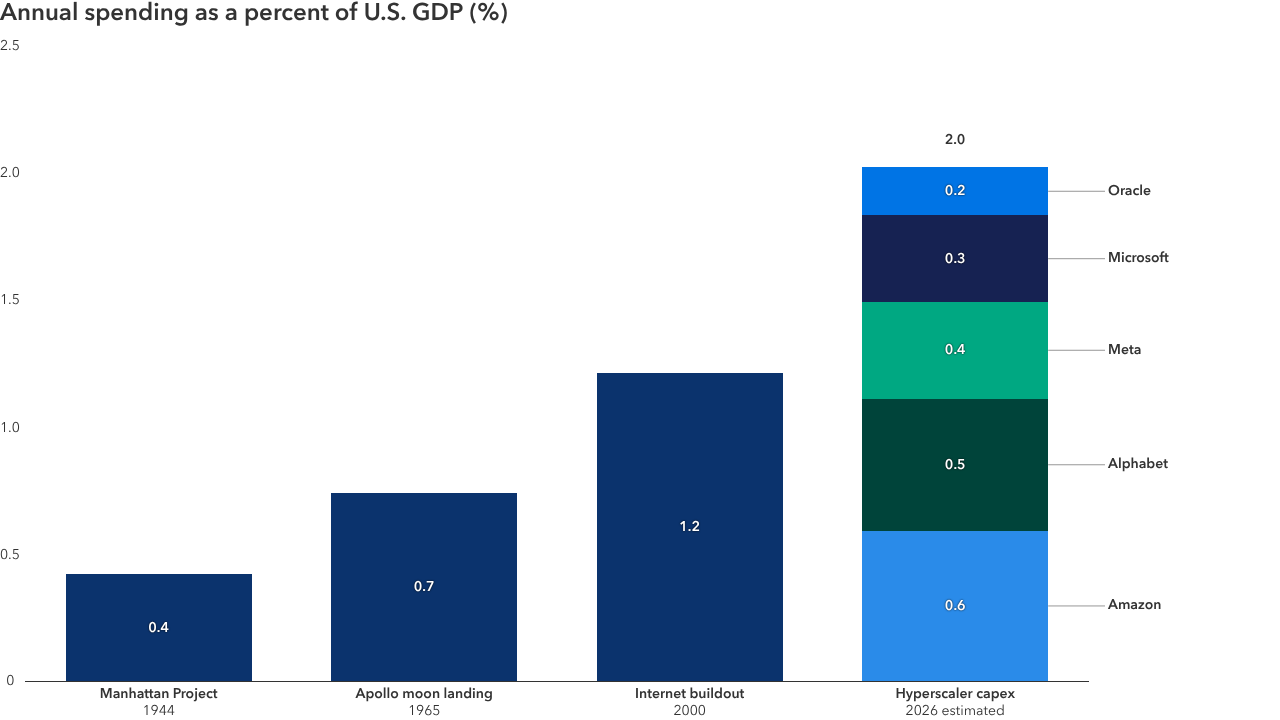
AI spending dwarfs history’s biggest moonshots

A stacked bar chart comparing estimated 2026 hyperscaler capex as a share of U.S. GDP with major historical U.S. technological projects. Hyperscaler (Alphabet, Amazon, Meta, Microsoft, and Oracle) 2026 capex is estimated at about 2% of GDP, compared with roughly 0.4% for the Manhattan project in 1944, 0.7% for the Apollo moon landing in 1965, and 1.2% for the internet buildout in 2000.
VIEW
Download

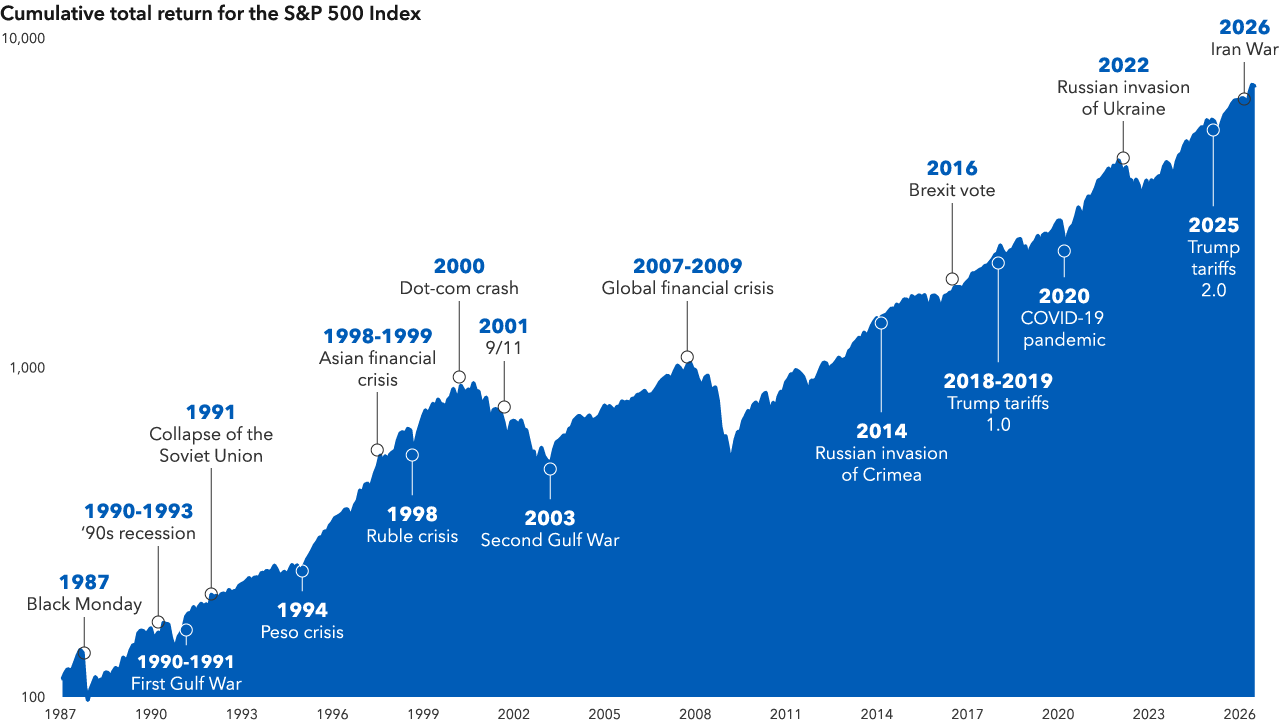
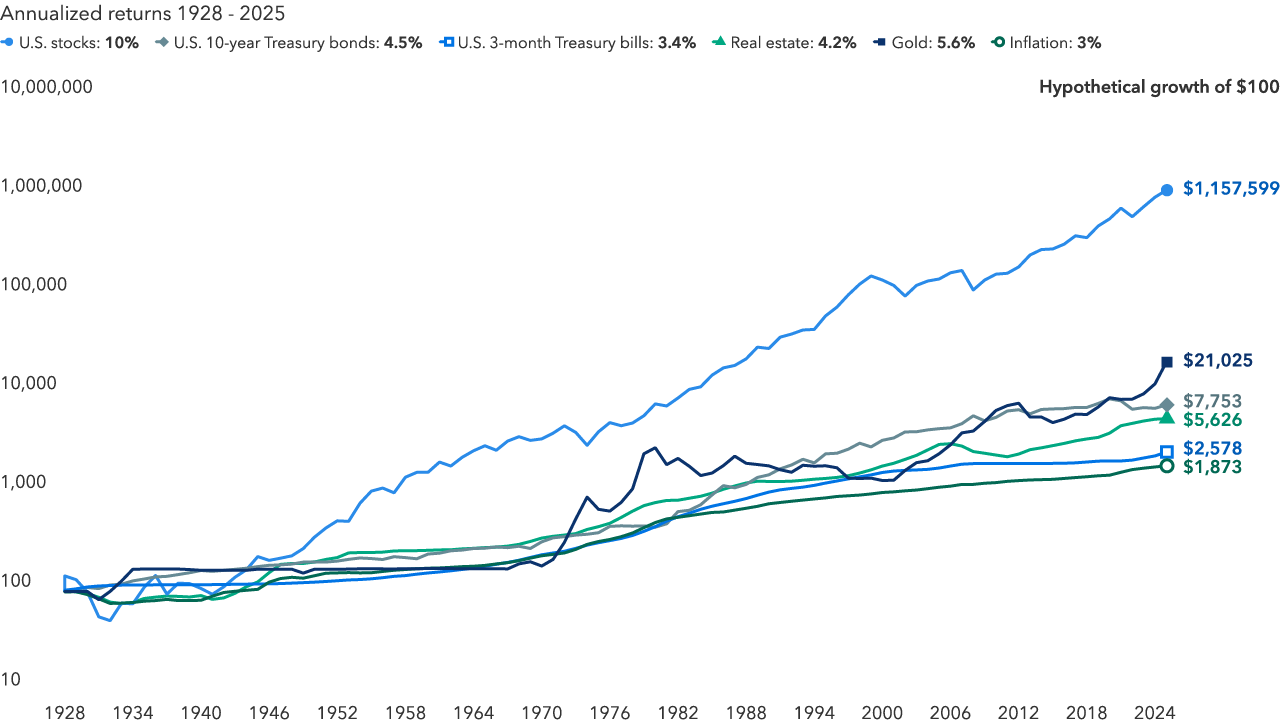
Markets have powered through previous crises

A mountain chart presents a long-term view of the S&P 500 Index’s cumulative total returns from January 1, 1987, through December 31, 2025, indexed to a starting value of 100. The chart is plotted on a logarithmic scale to better visualize percentage changes over time. It highlights the market’s performance across more than three decades, marking key global and economic crises along the timeline. These include events such as Black Monday (1987), the Gulf Wars, the collapse of the Soviet Union, the dot-com bubble burst, 9/11, the global financial crisis (2007 to 2009), Brexit, the COVID-19 pandemic, and the Russian invasions of Crimea (2014) and Ukraine (2022). Each event is marked along the timeline to show how the market reacted during and after these periods. Despite significant downturns during crises, the overall trajectory of the S&P 500 has trended upward.
VIEW
Download

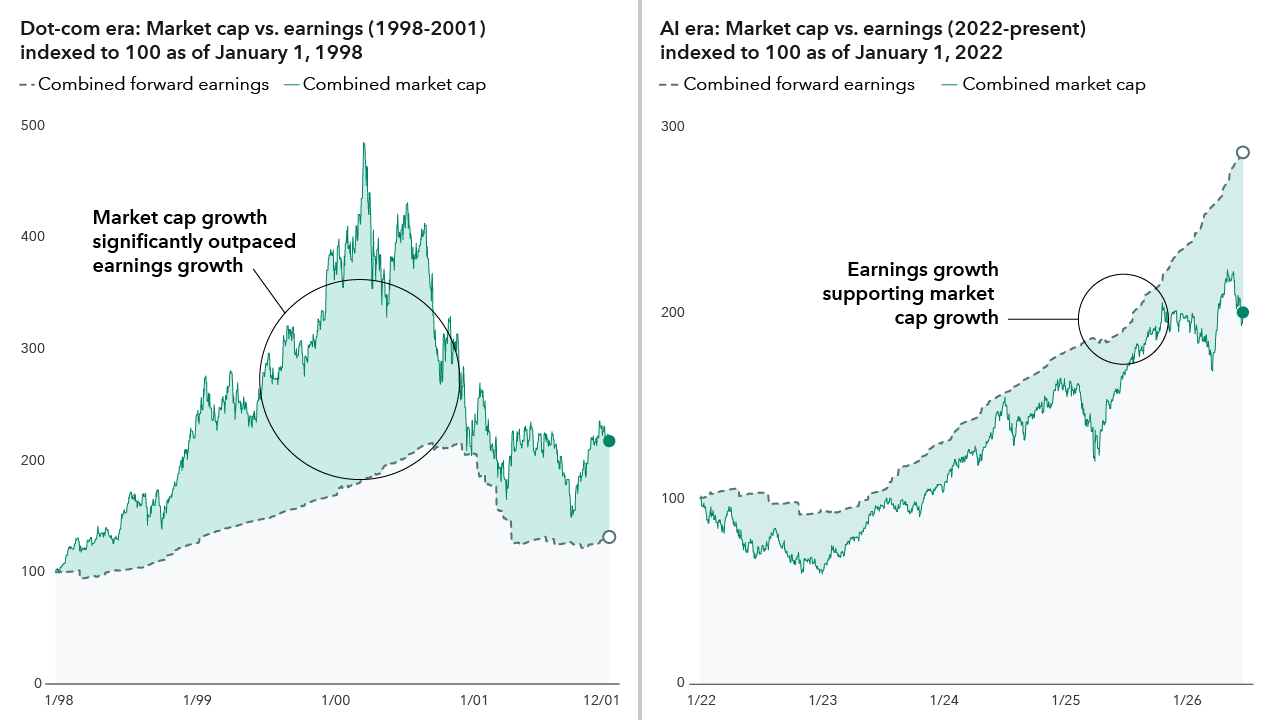
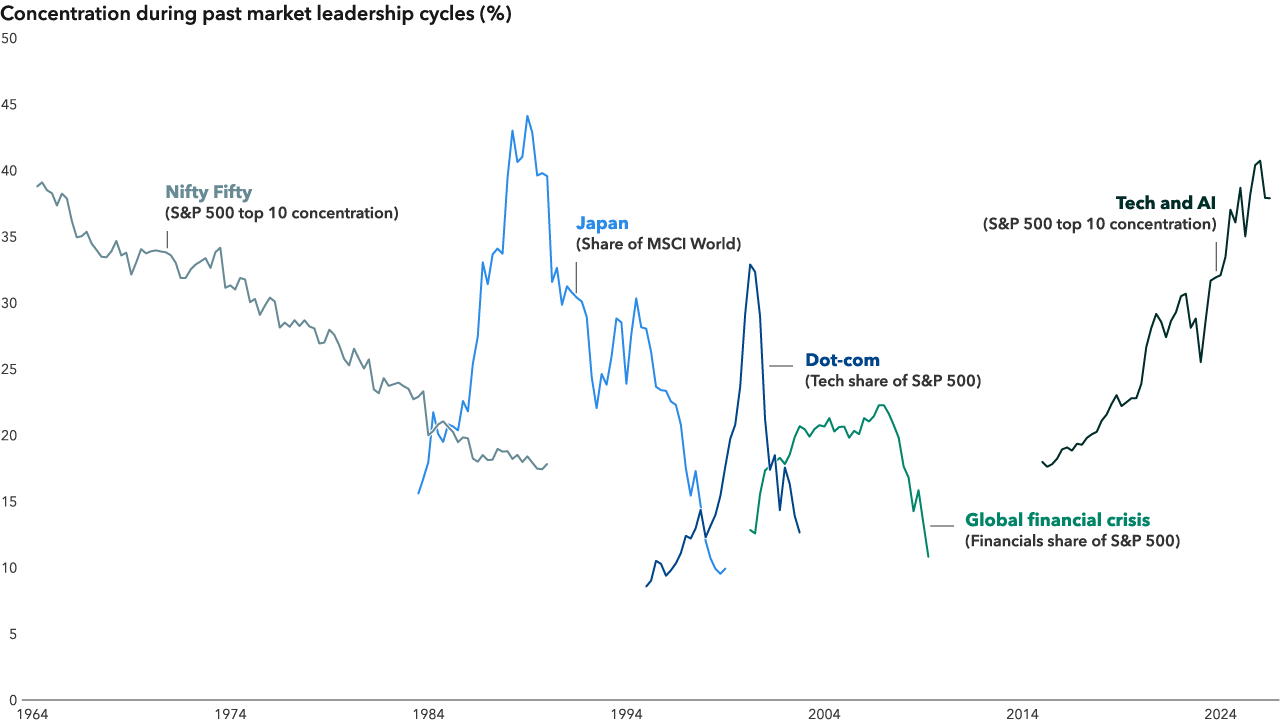
Why AI may not be a bubble

LEFT: Two horizontal lines represent the changes between the combined market cap and combined forward earnings for Microsoft, Cisco, Intel, and Dell from 1998 to 2001, indexed to 100 as of January 1, 1998. The chart illustrates the market bubble that formed during the dot-com era, as the growth in the combined market caps far surpassed their growth in earnings. Market caps peaked on March 23, 2000, before the bubble burst, leading to a sharp decline and eventual convergence with earnings by early 2001. RIGHT: Two horizontal lines represent the changes between the combined market cap and combined forward earnings for NVIDIA, Microsoft, Apple, Amazon, Meta, Broadcom, and Alphabet from 2022 to 2026, indexed to 100 as of January 1, 2022. The chart illustrates that while market cap has surged since 2022, earnings growth has been even stronger.
VIEW
Download

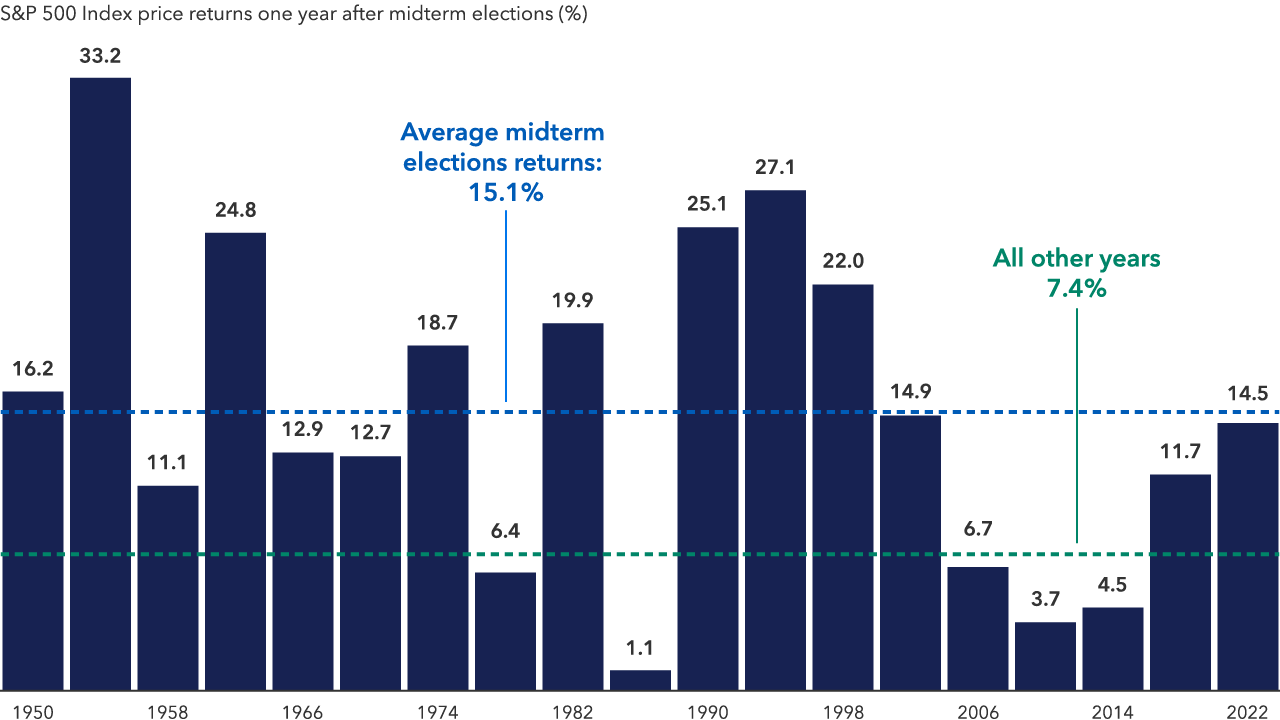
Markets have rebounded sharply after midterm elections

A horizontal bar chart showing the one‑year returns of the S&P 500 following every U.S. midterm election from 1950 through 2023. The chart highlights that there has not been a single negative one‑year return after any midterm election during this period.
VIEW
Download

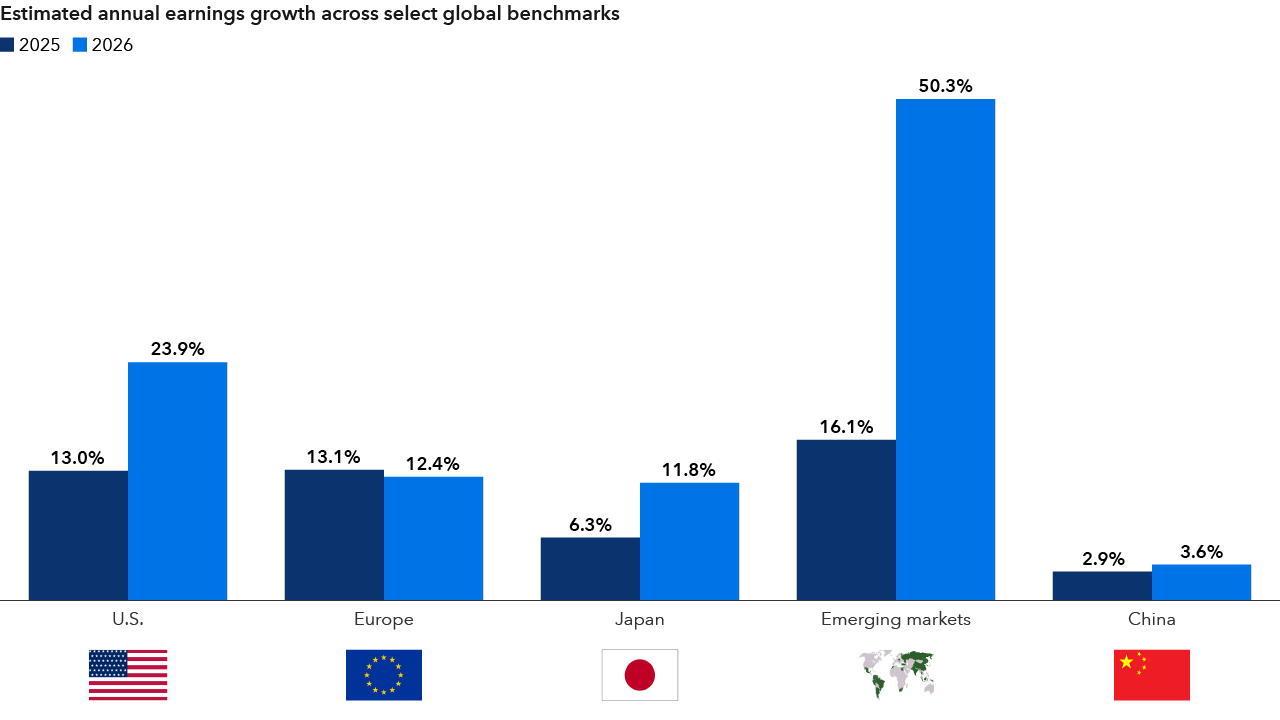
Company profits are expected to rise worldwide

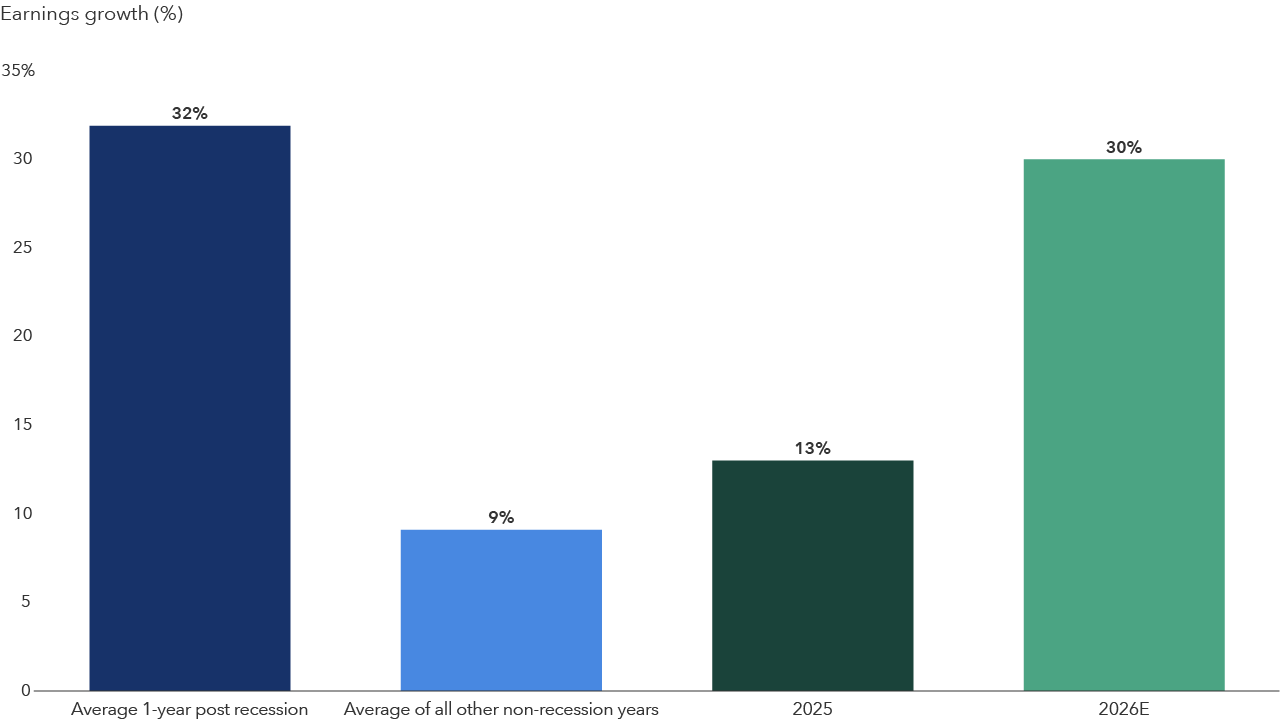
A series of vertical bars shows estimated annual earnings growth for 2025 and 2026 across major regions.
VIEW
Download

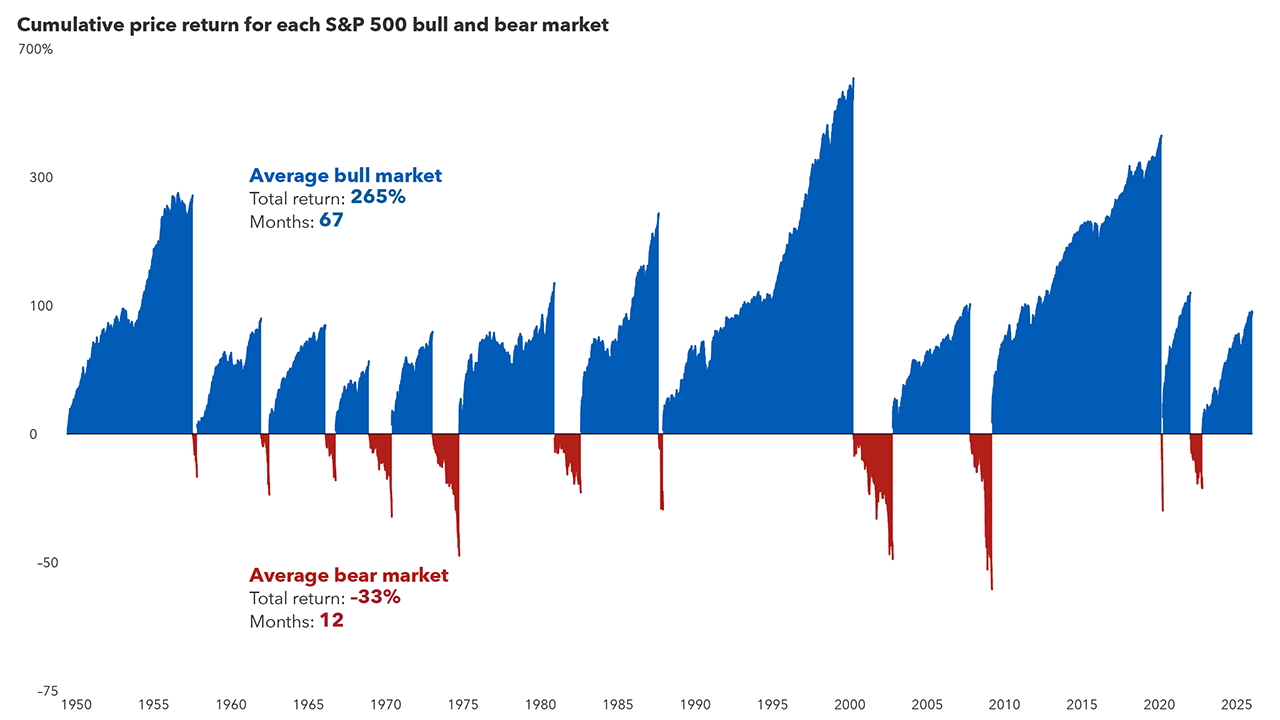
Bull markets have been much longer and stronger than bears

An area chart showing the cumulative S&P 500 price return of all U.S. bull and bear markets since 1949. The average bull market had a 265% total return and a duration of 67 months. The average bear market had a –33% total return and a duration of 12 months.
VIEW
Download

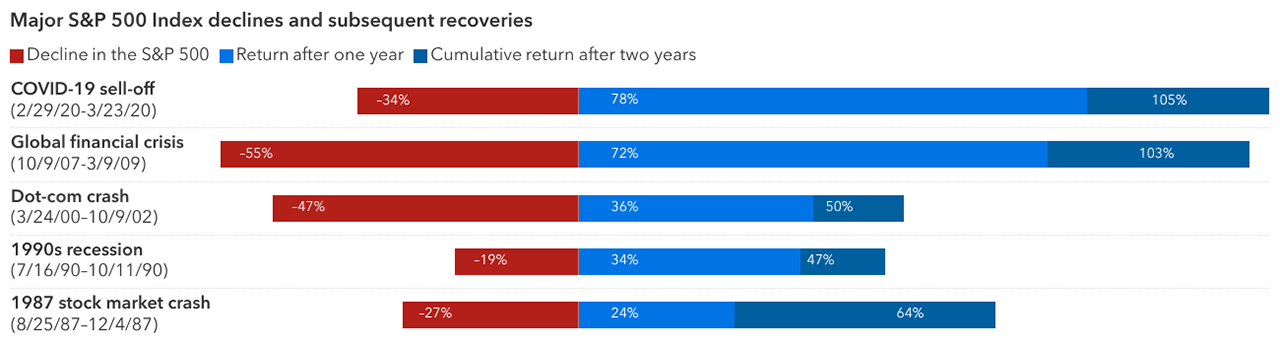
After large declines, stocks can recover quickly

A bar chart showing the five largest U.S. stock market (S&P 500) declines and the subsequent recovery 1-year and 2-years after bottoming.
VIEW
Download

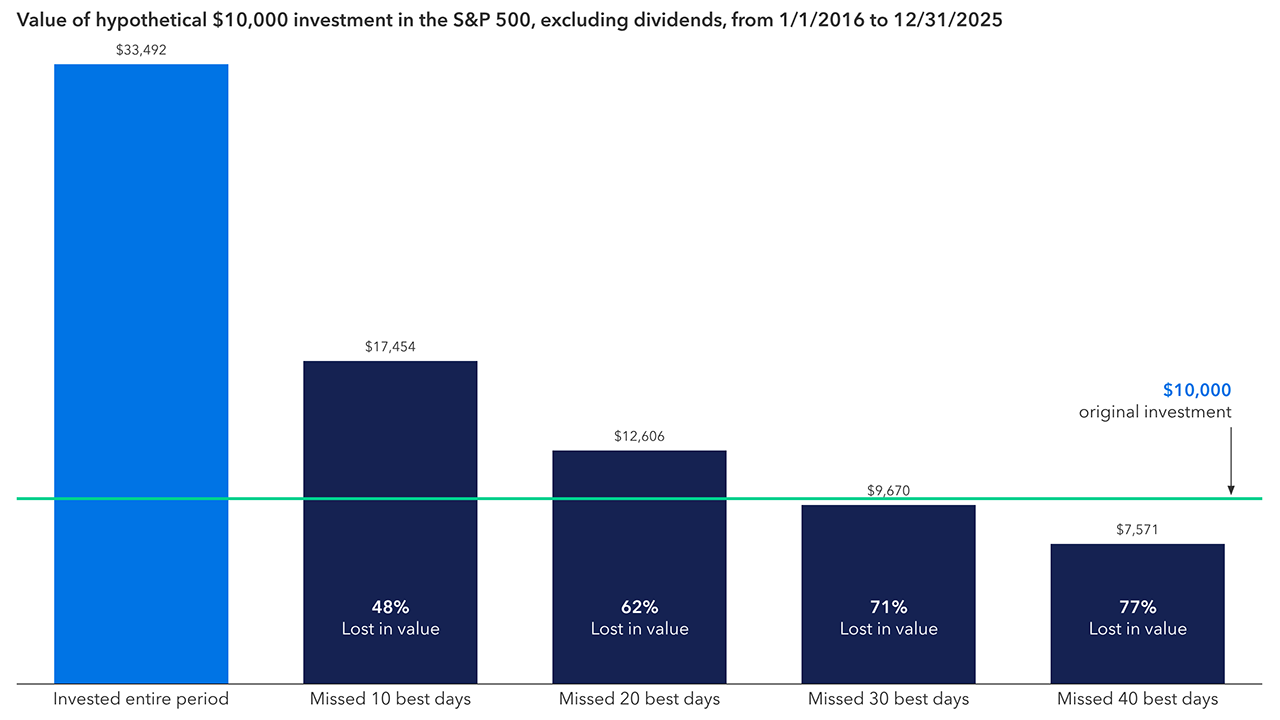
Timing the market can be costly

A bar chart showing S&P 500 returns from 2016 to 2025, comparing being fully invested for the entire period to missing the best market days. Missing the top 10 days cuts the value nearly in half; missing 20, 30, and 40 days reduces it to roughly 40%, 30%, and 20% of the fully invested value.
VIEW
Download

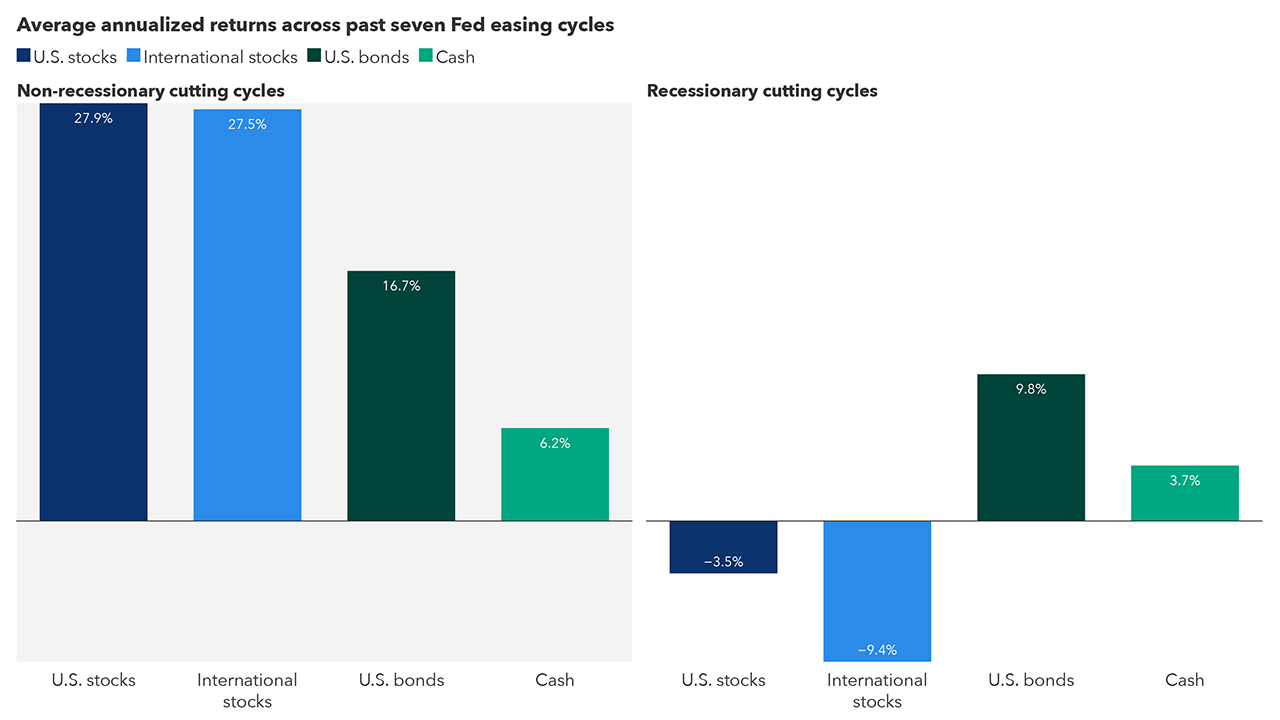
Fed interest rate cuts can be good for stocks and bonds

Two vertical bar charts compare average annualized returns across U.S. stocks, international stocks, U.S. bonds, and cash during the last seven Federal Reserve interest rate cutting cycles. One chart represents non-recessionary cutting cycles, the other recessionary cutting cycles. Returns are notably higher in non-recessionary periods: 27.9% for U.S. stocks, 27.5% for international stocks, 16.7% for U.S. bonds, and 6.2% for cash. In contrast, recessionary cycles show lower or negative returns: -3.5% for U.S. stocks, -9.4% for international stocks, 9.8% for U.S. bonds, and 3.7% for cash.
VIEW
Download

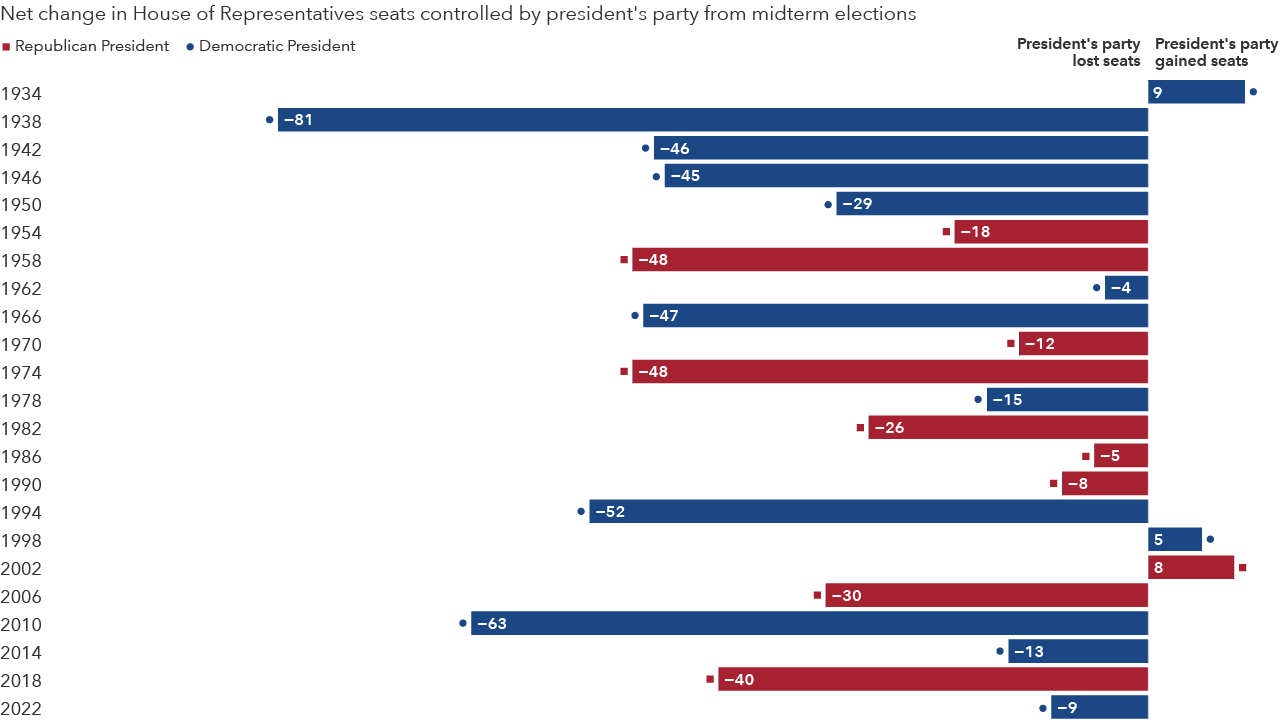
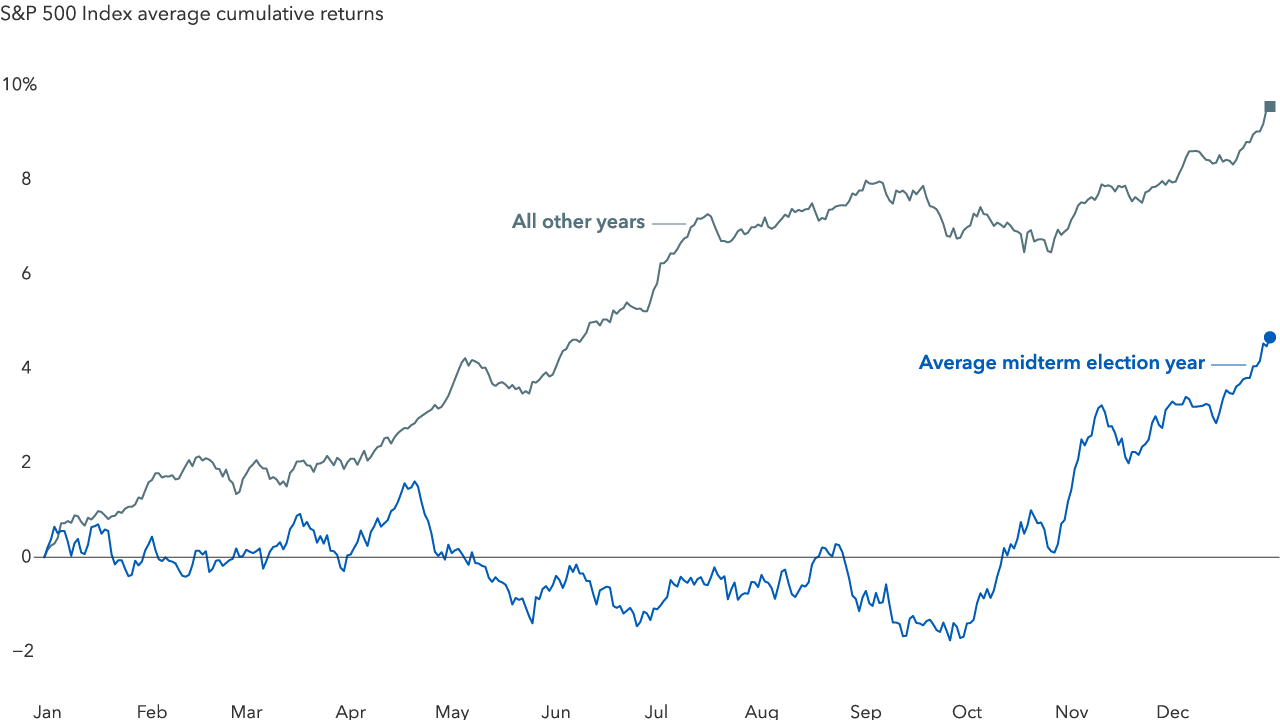
Midterms: historically choppy markets followed by late-year rally

A line chart compares average S&P 500 year‑to‑date returns in midterm election years versus all other years from January through December, beginning in 1931. The "all other years" line trends steadily higher throughout the year, while the midterm‑year line hovers between +1% and negative 2% until late in the year, before rising in November and December.
VIEW
Download

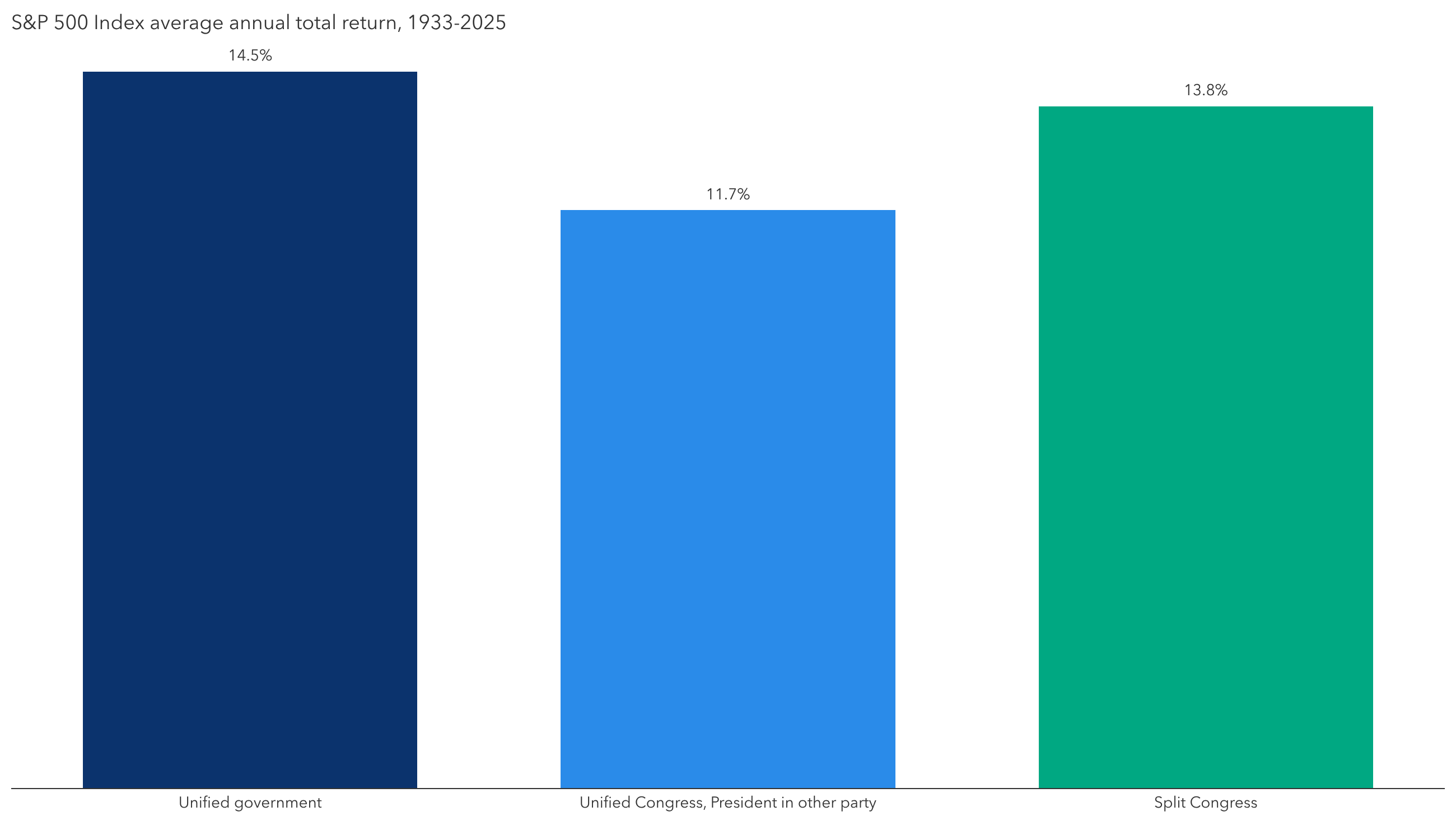
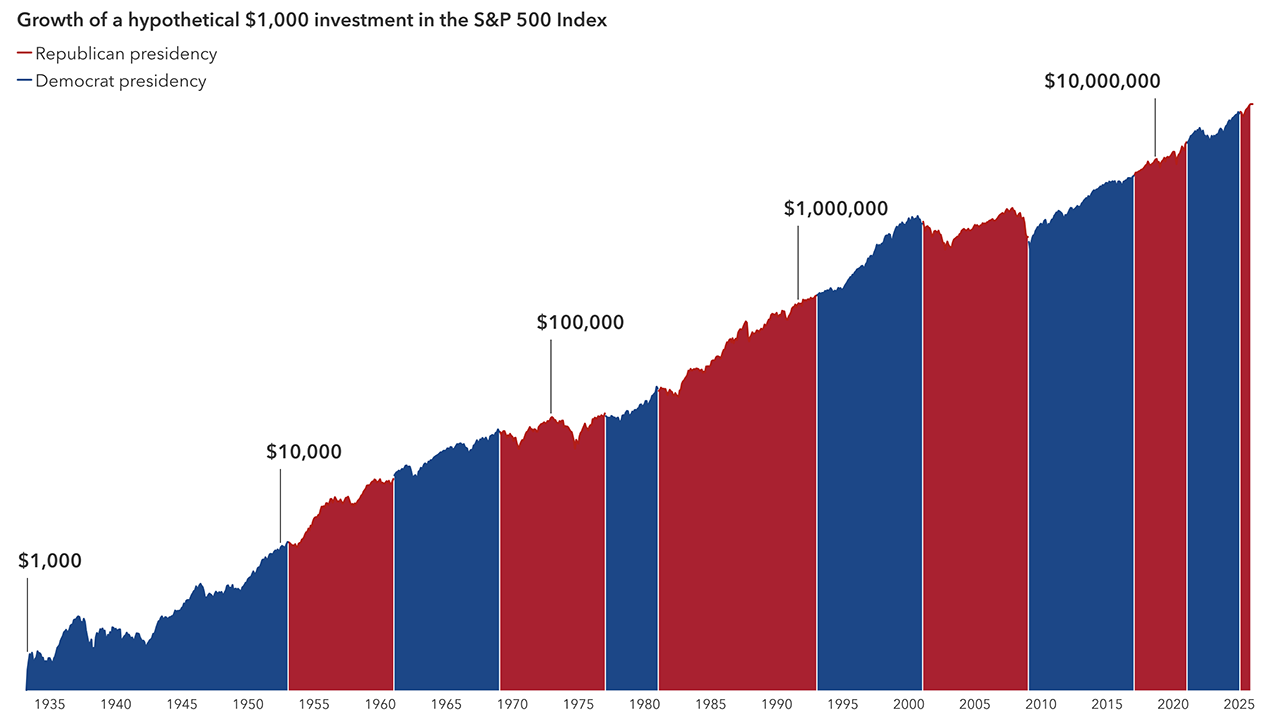
Stocks have trended higher regardless of which party was in office

An area chart illustrating how a hypothetical $1,000 investment made on March 4, 1933 grew steadily through December 31, 2025, reaching a value of $31.7 million. The visualization highlights long‑term market resilience across political administrations and periods of volatility.
VIEW
Download

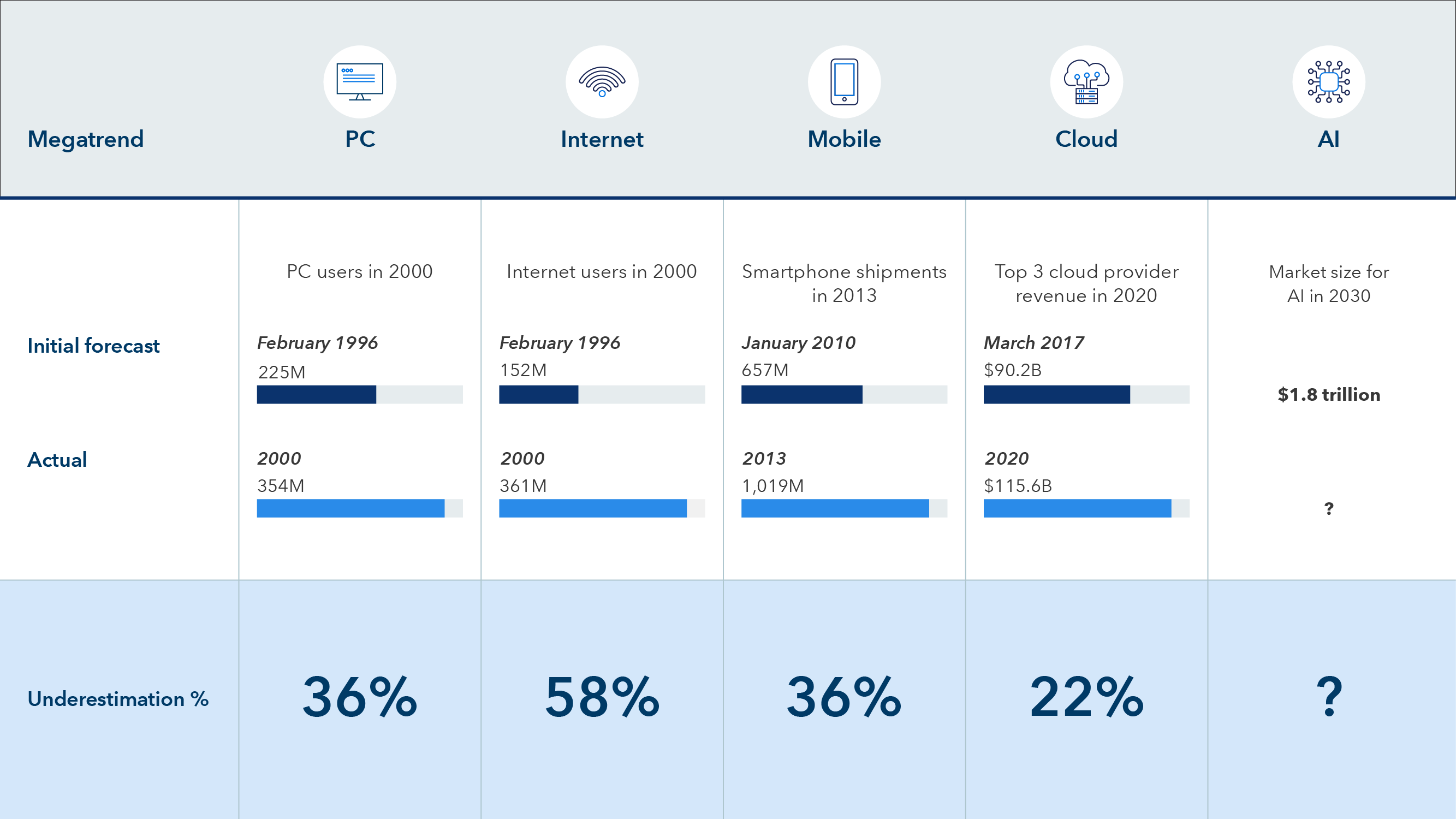
Investors have underestimated the long-term impact of new tech

An infographic compares initial forecasts with actual adoption for the PC, internet, mobile, and cloud technology revolutions. In every case, forecasts underestimated adoption, by an average of 38%.
VIEW
Download

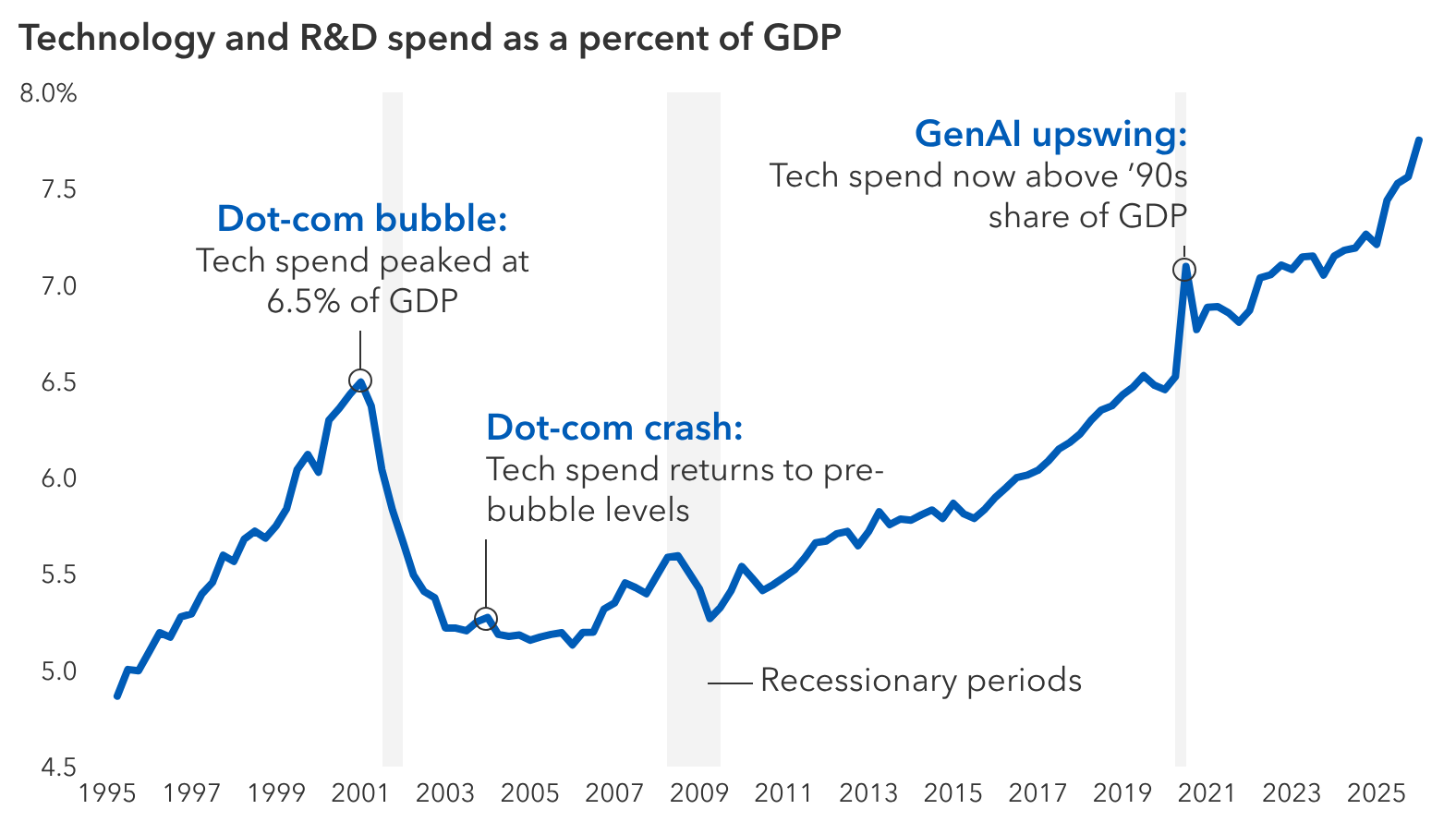
AI spending has surpassed the dot-com mania

A line chart which shows U.S. technology and R&D spending as a percentage of GDP from 1995 to 2025. In 2020, spending surpassed the dot-com peak of 6.5% and has since grown to 7.7%, driven by increased investment in generative AI.
VIEW
Download

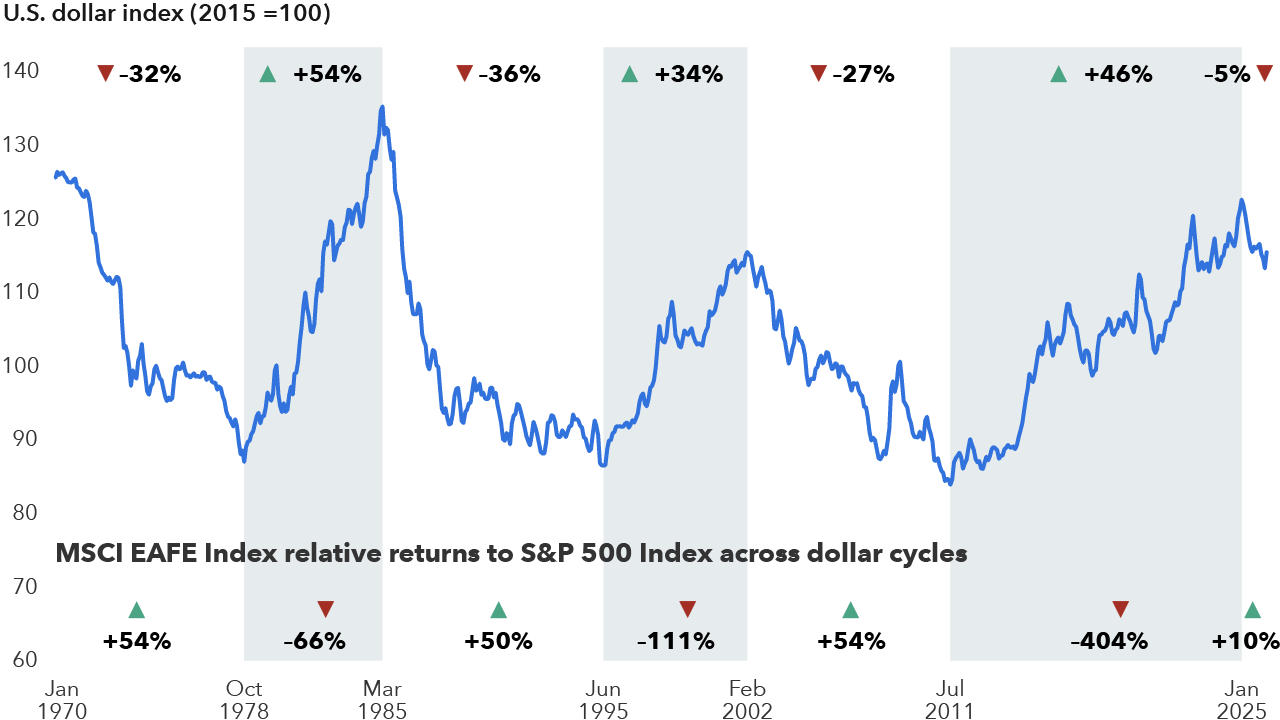
U.S. and international stocks take turns leading

A line chart shows the U.S. dollar index, rebased to 100 in 2015, from 1970 to 2026. The chart highlights periods of dollar strength and weakness alongside relative total returns in U.S. dollars for international stocks (MSCI EAFE) compared to U.S. stocks (S&P 500). Periods of dollar weakness have generally coincided with stronger relative performance for international stocks.
VIEW
Download
Investments are not FDIC-insured, nor are they deposits of or guaranteed by a bank or any other entity, so they may lose value.
Investors should carefully consider investment objectives, risks, charges and expenses. This and other important information is contained in the mutual fund prospectuses and summary prospectuses, which can be obtained from a financial professional and should be read carefully before investing.
All Capital Group trademarks mentioned are owned by The Capital Group Companies, Inc., an affiliated company or fund. All other company and product names mentioned are the property of their respective companies.
Use of this website is intended for U.S. residents only. Use of this website and materials is also subject to approval by your home office.
Capital Client Group, Inc.
This content, developed by Capital Group, home of American Funds, should not be used as a primary basis for investment decisions and is not intended to serve as impartial investment or fiduciary advice.